

Competency-based learning.
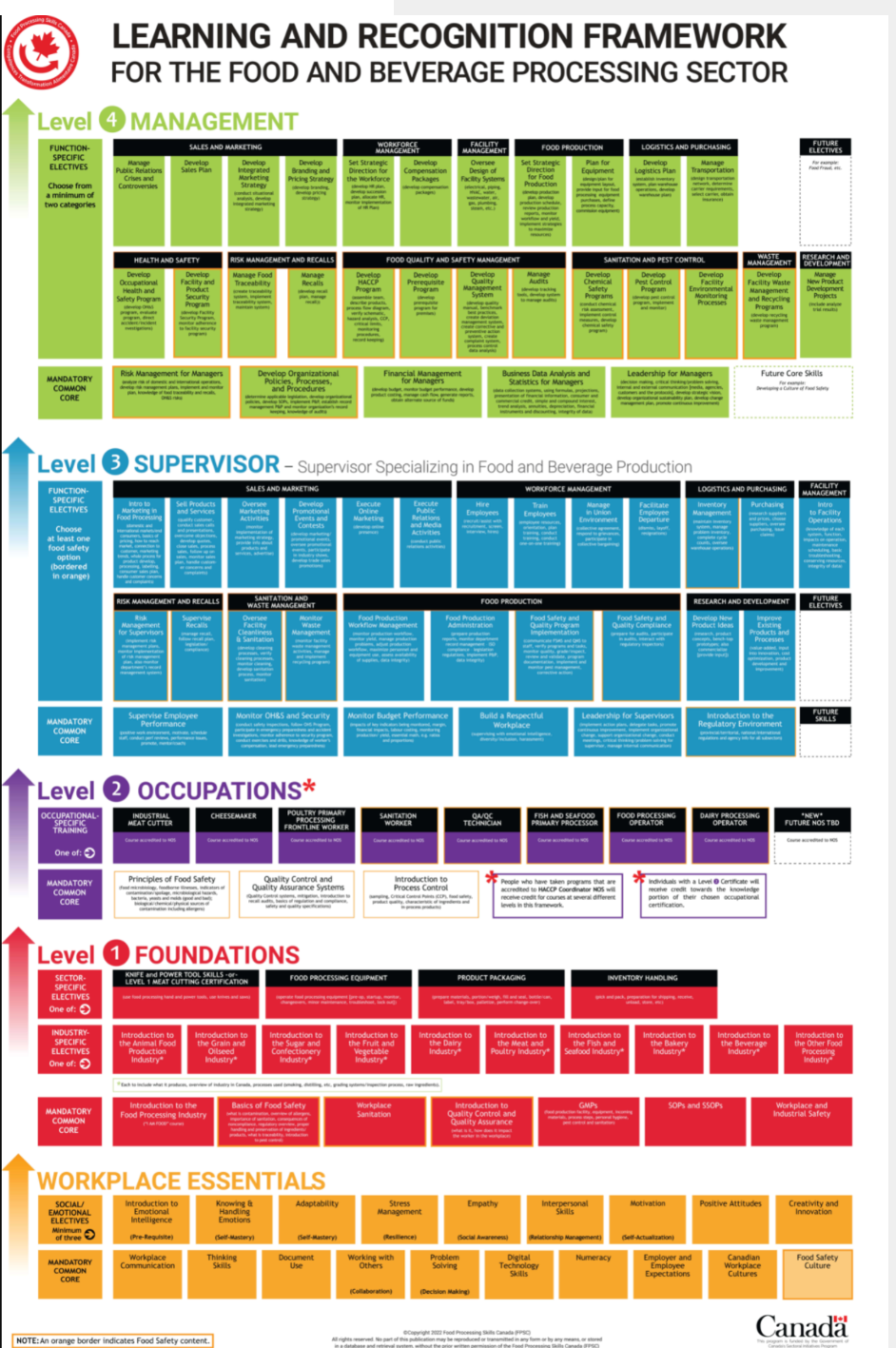
Our Learning & Recognition Framework (LRF) is a documented model developed by industry that defines each and every qualification included within a comprehensive occupations structure. While no national governmentally-administered qualifications exist for the food and beverage manufacturing industry in Canada, FPSC has identified a need to clearly articulate the recognition levels for jobs.
This framework is unlike a national qualifications framework in that it is not tied to typical educational designations such as diploma or degree, but instead has organized nationally-validated industry competencies into a logical structure with a training focus. The framework includes levels customized to the food and beverage processing sector, and includes several microcredentials at the lower levels. Visit FPSC’s website to learn more about the LRF.
Micro-curriculum
| I AM FOOD: Introduction to the Food & Beverage Manufacturing Industry | 3 hours | This course serves as both an introduction and onboarding tool for anyone wanting to learn more about Canada’s Food and Beverage Manufacturing Industry. Whether you are deciding if this field is right for you or you’ve recently started a new position, this course was designed for you. You will have a chance to explore the importance of the industry and the critical role it plays in the lives of Canadians. Jam-packed with critical information for your career advancement, you will explore the dimensions of the Canadian labour market, national occupational standards, and key educational & training opportunities. |
| Good Manufacturing Practices (GMPs) | 3 hours | This course will discuss how food workers need to act, dress and be aware of food safety hazards and how they can prevent them. This course will provide you with the knowledge and skills to understand how GMPs support safe food manufacturing and your role in supporting GMPs. You will be able to identify food safety hazards and understand how food workers behavior and can have either a positive or a negative impact on food safety. This course will provide you with the knowledge and skills to understand how GMPs support the safe manufacturing of food and how to implement GMPs. |
| Lock Out Tag Out | 2 hours | This program is designed to introduce to the topic of Lock Out – Tag Out (LOTO), so you can better comprehend the occupational health and safety instructions given to you on the job as they relate to LOTO and its broader safety topic of energy isolation. |
| Distribution and Warehouse Food Safety | 4 hours | Canada has one of the best food safety systems in the world. That’s because businesses have a good record in food safety and the government has a good reputation for keeping the food supply safe. Employees involved in shipping, receiving and warehousing of foods are part of the reason for this. This course will help you understand your role in Good Warehouse Practices and the food safety practices that apply in food processing companies, distribution centres and logistics firms. |
| Oral Communications | 2 hours | In the workplace, we communicate with each other in many different ways, from writing messages to using hand signals. One of the most common ways that we communicate in the workplace is by speaking with others. Good workplace communication skills are very important. The best communicators use strategies and techniques to get their message across. During this course, you will learn that using the tips and tools of successful workplace communication will be well worth your time and effort! |
| Employer Employee Expectations | 2 hours | This course will provide you with the knowledge and skills to understand what is expected of you as an employee within a Canadian Workplace. Being familiar with and meeting these expectations are important to job success and career advancement in Canada. Workplace expectations differ in every country. Canadian workplace culture expects individuals to be competent in speaking, listening and socializing with other people; to know the etiquette of working harmoniously with co-workers and supervisors; and to understand and respect cultural differences in the workplace. Employees are also expected to know general business etiquette, how to dress for the production floor and the office environment, and their rights and obligations in the Canadian workplace. Being familiar with and meeting these expectations are important to job success and career advancement in Canada. |
| Allergens Level 1 | 3 hours | This course covers the priority list of allergens in Canada as well as sulphites and gluten sources. You will be able to identify the sources and describe the best practices and regulations to prevent allergens related food safety incidents. |
Sanitation Level 1 | 2 hours | This course covers the cleaning and sanitation of food contact surfaces, equipment and utensils. You will be able to describe the steps to clean and sanitize effectively, choose and prepare cleaning and sanitizing solutions, as well as learn the best practices to protect yourself while doing it. |
| Food Safety Culture and You | 2 hours | This course discusses the importance of following food safety procedures and practices when working in Canadian food companies, as these are part of food safety culture. It outlines the role of governments and food companies in protecting the food supply and identifies how consumers can be negatively affected by improper practices. It covers the important role food workers have in following procedures and telling supervisors and coworkers of food safety problems. Participants will learn the important role of food workers have in supporting their workplace food safety culture. By following food safety practices, food workers help their employer to protect the consumer, meet government regulations and address business needs. |
| Positive Attitudes in the Workplace | 3 hours | Attitude is everything! You may be the most skilled or competent person at work, but if you do not accompany your ability to do your job well with a positive attitude, your success will be limited. Your attitude is about “how you do your job” and how you choose to behave in all circumstances. It is how you convey yourself to others. Most employees with positive attitudes display several favorable behaviours in the work environment. They are resilient, resourceful, flexible, and open-minded. They radiate inviting energy that positively affects everyone and everything around them. If you can display to your employer, customers and colleagues a sense of positivity, you will quickly become someone they will want to deal with more. The purpose of this course is to equip you with knowledge, tools and practical strategies that will help you develop and maintain a positive attitude so that you can elevate both your professional and personal success. |
Working with Others | 2 hours | Working with Others includes working with a partner or a team to complete your tasks. Every employee in a food processing facility has to work with others during the day, whether you have to collaborate with workers from another department to solve a production issue or work as a member of a larger team to complete a rush order. Being able to work well with others is a skill that your employer greatly appreciates. There are many different professional behaviours and attitudes, such as:
Throughout this course, we take a closer look at the importance of Working with Others in the food processing industry and discover ways that you can enhance your skills as a partner or a team member. |
| Digital Technology Skills | 3 hours | This course will cover how digital technology involves using digital tools and software; applying security measures to protect the hardware, software and personal data; and understanding using digital information. |
| Transferable Skills | 1 hour | This course is about the skills we use in our daily lives, the skills we take with us in new situations, and the skills we use on the job. We will explore their relationships with each other and how we can apply these skills to finding careers in Food Processing. |
| Canadian Workplace Cultures | 3 hours | Canada is a vast country with many different cultures. Understanding what makes Canada such a diverse country is a critical skill in being a team member in a Canadian workplace. There are various aspects of a Canadian workplace that may not be the same as a workplace in other countries. We will take a close look at topics such as basic Canadian facts, appropriate workplace etiquette including body language, communication skills and common courtesies, as well as the importance of demonstrating adaptability, work ethic, and work initiative. |
| Oral Communication | 2 hours | In the workplace, we communicate with each other in many different ways, from writing messages to using hand signals. One of the most common ways that we communicate in the workplace is by speaking with others. Good workplace communication skills are very important. The best communicators use strategies and techniques to get their message across. During this course, you will learn that using the tips and tools of successful workplace communication will be well worth your time and effort! |
| Digital Technology | 3 hours | This course will cover how digital technology involves using digital tools and software; applying security measures to protect the hardware, software and personal data; and understanding using digital information. |
| Industrial Workplace Safety | 4 hours | Worker safety is of premier importance. Food processing is often on an industrial scale with automated equipment and many potential hazards. Being aware and trained to deal with these potential hazards and workplace situations is critical for employee safety. This course will provide workers in the food processing industry with knowledge of the safety requirements necessary to ensure a healthy and safe work environment. |
| Lock Out Tag Out | 2 hours | This program is designed to introduce to the topic of Lock Out – Tag Out (LOTO), so you can better comprehend the occupational health and safety instructions given to you on the job as they relate to LOTO and its broader safety topic of energy isolation. |
| Good Manufacturing Practices (GMPs) | 2 hours | This course will discuss how food workers need to act, dress and be aware of food safety hazards and how they can prevent them. This course will provide you with the knowledge and skills to understand how GMPs support safe food manufacturing and your role in supporting GMPs. You will be able to identify food safety hazards and understand how food workers behavior and can have either a positive or a negative impact on food safety. This course will provide you with the knowledge and skills to understand how GMPs support the safe manufacturing of food and how to implement GMPs. |
| Sanitation Level 1 | 2 hours | This course covers the cleaning and sanitation of food contact surfaces, equipment and utensils. You will be able to describe the steps to clean and sanitize effectively, choose and prepare cleaning and sanitizing solutions, as well as learn the best practices to protect yourself while doing it. |
| Allergens Level 1 | 3 hours | This course covers the priority list of allergens in Canada as well as sulphites and gluten sources. You will be able to identify the sources and describe the best practices and regulations to prevent allergens related food safety incidents. |
| Basics of Standard Operating Procedures (SOPs) and Sanitation Standard Operating Procedures (SSOPs) | 3 hours | This coursed is designed for front-line workers and it will detail the fundamental requirements of Standard Operating Procedures and Sanitation Standard Operating Procedures in the food and beverage manufacturing industry. |